
WHAT IS MACULAR DEGENERATION?
SYMPTOMS
CURRENTLY AVAILABLE TREATMENTS
CASE STUDIES
CONTACT FOR MORE INFORMATION
Macular Degeneration is the most common cause of vision loss in Caucasian men and women aged 50 years and older. In 2010, this retinal disorder affected more than 23 million people globally. Because it typically affects older people, it is also known as “age-related” macular degeneration.
A complex disease involving multiple genetic and environmental factors which are presently not well understood, this degenerative eye disease is the third most common cause of blindness worldwide – affecting the sight of more adults than glaucoma, cataracts and diabetic retinopathy combined!
There are two types of macular degeneration. Dry Macular Degeneration accounts for roughly 85-90% of all cases, is painless and almost never leads to total blindness.
Dry macular degeneration can sometimes progress unpredictably to the relatively rare but much more dangerous “wet” form of this disease.
What Causes Macular Degeneration?
Macular degeneration is a complex disease involving multiple genetic and environmental factors, which are presently not well understood.
During normal aging, yellowish deposits called drusen – believed to be made up of waste products – form under the retina. As drusen increase in size and number, they begin to interfere with the retina’s ability to process incoming light into vision by damaging or killing photoreceptor cells in the macula.
The macula is a tiny area right at the very center of the retina which is responsible for sharp, straight-ahead vision.
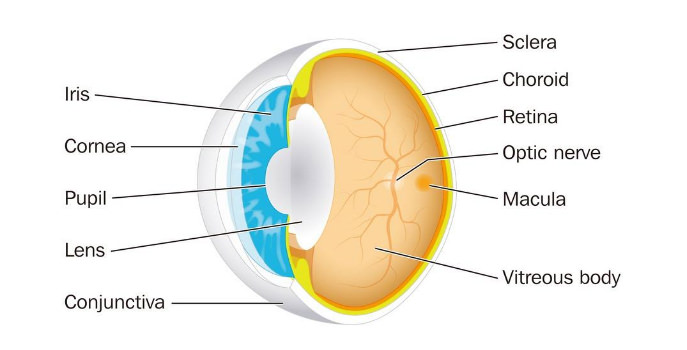
Because the macula’s photoreceptor cells enable us to have sharp, detailed vision, patients with macular degeneration typically experience a blurring and dark spots in their central vision.
Straight lines may appear distorted or warped. As the disease progresses, blind spots form within the central visual field.
This profoundly affects the ability to perform daily activities such as reading, driving, or even recognizing the face of a friend or family member.
Vision in both eyes is affected – although not to the same extent.

Blurring and darkening of central vision seen in Macular Degeneration (right) relative to normal vision (left) (from www.scienceofamd.org)
What are the Risk Factors for Macular Degeneration?
The leading risk factors include:
- Age – the older, the higher the risk especially after 50 years
- Smoking
- Family history
- Blue or light-colored eyes
- A diet low in dark-green leafy vegetables rich in the antioxidants lutein and zeaxanthin, which are believed to reduce the risk of developing macular degeneration
- A diet too high in omega-6 fats and too low in omega-3 fats, which may promote development of this eye condition
Both men and women are equally at risk.
Also, growing evidence suggests that genetic factors may also play a part in the risk for developing macular degeneration. For instance, people who have a close relative with this retinal disorder are 3 times more likely to develop it than those who don’t.
Also, if one identical twin has macular degeneration, it is 100% certain the other will develop it too. In fraternal twins and siblings, the shared rate of risk is 50%.
What Do You Need to Know About Macular Degeneration?
As we saw earlier, dry macular degeneration accounts for roughly 85-90% of all cases, is painless and almost never leads to total blindness; some usable ‘peripheral’ vision is always retained.
If you suffer from this devastating eye condition, it’s sadly inevitable that you will experience progressive loss of your central vision. However, your vision loss may be so slow that you may be completely unaware of it until it’s too late.
In rare instances, dry macular degeneration can also progress unpredictably to the much more dangerous “wet” form, which causes rapid and crippling vision loss.
For both these reasons, it’s critically important that you undergo yearly eye checkups if you’re 45 years or older – so that either dry or wet macular degeneration can be detected if present and further retinal damage and vision loss can be prevented.
If you have a family member that has already been diagnosed with this eye condition, we strongly recommend that you and your family members get your eyes checked immediately by an ophthalmologist who is specially trained to detect retinal diseases.
If you have been diagnosed with macular degeneration, you are likely to experience one or more of the following symptoms −
- Blurred Vision – a typical symptom, with objects appearing an unusual size or shape along with difficulty in discerning details, both up close and from a distance. You may also notice distortions of lines and shapes.
Because macular degeneration typically begins in one eye, your remaining good eye will typically compensate for vision loss. So it may be some time before the second eye is seriously affected enough for you to notice vision problems. - Dramatic Loss of Visual Acuity – you are likely to experience a drastically decreasing visual acuity, for example from 20/20 to 20/60 or even 20/80.
Note: “Visual acuity” means clarity or sharpness of vision and is measured separately for each eye. 20/20 vision is normal vision. If you have 20/20 vision, you can see objects in clear detail at 20 feet which the average person can see at that distance.
A visual acuity of 20/80 means that a person will only be able to see objects in clear detail from 20 feet away which the average person can see in clear detail from 80 feet away. This is a dramatic and very serious loss of vision. - Central Scotomas – you may see shadows or have missing areas in your vision, typically seen as blank spots or dark areas in the center of the vision field.
- Diminished Color Vision – you may experience difficulties in distinguishing between colors, specifically dark ones from dark ones and light ones from light ones.
Peripheral vision and night vision usually remain unaffected in macular degeneration. - Metamorphosia – this is a type of distorted vision in which a grid of straight lines appears wavy and parts of the grid appear blank.
- Exudations – these include hemorrhages in the eye, hard exudates as well as fluid accumulation in the sub-retinal, sub-retinal pigment epithelium (RPE) and intra-retinal spaces of the eyes.
- Increased Sensitivity to Light – this is typically manifested as slow vision recovery after exposure to bright light, known as the ‘photo-stress test’. You may even see lights that don’t exist.
Unfortunately, it is impossible to predict how quickly macular degeneration will progress, whether a patient will get it only in one eye or both eyes, and to what extent vision will be lost over time.
Several new drugs are being investigated for the treatment of macular degeneration. A few have been approved for the treatment of “wet” macular degeneration, which accounts for only 10-15% of all cases.
However, there are presently no approved or proven treatments for dry macular degeneration…even though 85-90% of patients (including likely yourself) suffer from this form.
If you have been diagnosed with this retinal disorder, eye health experts recommend stopping smoking and embarking on a healthy diet that includes a lot of dark green leafy vegetables and fruits.
That’s because these foods contain the carotenoid antioxidants zeaxanthin, meso-zeaxanthin and lutein, which naturally accumulate in the macula and are collectively known as “macular pigment”.
There is a growing belief that each of these 3 components of macular pigment is important for optimal visual performance and can protect retinal photoreceptor cells from damage when given as supplements.
Similarly, “AREDS-2” (second Age-Related Eye Disease Study) supplements may slow ongoing vision loss in macular degeneration. These supplements include zinc, copper, the antioxidants vitamin E and vitamin C, lutein, zeaxanthin and the omega-3 fatty acids docosahexanoic acid (DHA) and eicosapentaenoic acid (EPA).
Although they are regarded as safe, vitamin supplements may also have harmful effects of their own upon long-term administration.
Eye care specialists also recommend maximizing remaining vision using low vision aids such as telescopic and magnifying lenses and other so-called “assistive technologies”.
While there is no question that these aids have made patients with macular degeneration better able to lead independent lives – the fact remains that no drug or treatment has been clinically proven to halt the progressive loss of vision seen in patients with dry macular degeneration.
Until today.
Incredibly, the breakthrough new treatment Rejuven-Eyes Bio-Therapy has been clinically proven to slow down vision loss – even restore lost vision – in patients with Dry Macular Degeneration.
No other vision loss therapy can do this.
BENEFITS OF REJUVEN-EYES BIO-THERAPY
- Stops Ongoing Vision Loss After Just One Treatment Course
This innovative therapy stopped ongoing vision loss quickly and painlessly in patients suffering from dry macular degeneration after just one course of treatment lasting 20 days.
- Restores Lost Vision
A significant proportion of patients reported a noticeable improvement in their eyesight on treatment with Rejuven-Eyes Bio-Therapy.
Yes, it’s true – they regained some of their lost vision.
- Is Clinically Proven to be 100% Safe
Not a single patient reported any side effects or adverse reactions. In other words, clinical data based on patient outcomes clearly confirms that Rejuven-Eyes Bio-Therapy is fast-acting, powerfully effective and 100% safe.
- Does Not Involve Intraocular Injections
This novel therapy is NOT injected directly into the eyes, but into the muscle like a flu shot. In fact, patients report that this treatment is comfortable and completely painless.
Patients with macular degeneration experience a gradual loss of their central vision.
This is because delicate “cone” photoreceptor cells in the central portion of the retina in their eyes – known as the macula – gradually stop working and die, likely because of a buildup of wastes in these cells and their supporting tissue.
Cone photoreceptor cells are present throughout the retina. However, they are very concentrated in the macula. Since cone photoreceptor cells are responsible for central vision, color perception and sharp images, or so-called “acute” vision – all of these are adversely affected in macular degeneration.
However, almost everyone with this eye condition will retain their peripheral vision. In other words, they will retain most of their independence and never progress to full blindness.
How does Rejuven-Eyes Bio-Therapy help to prevent ongoing vision loss, even restore lost vision in patients with Dry Macular Degeneration?
This synergistic formulation of small but therapeutically potent “retinoprotective” peptides halts ongoing damage of both rod and cone photoreceptor cells. This innovative new therapy is also believed to trigger the formation of new, healthy photoreceptor cells!
For instance, one of the main components of Rejuven-Eyes Bio-Therapy known as Retinalamin has been shown to trigger formation of new retinal cells in laboratory conditions, while also significantly improving visual acuity and expanding the field of vision in patients.
Another component known as Epitalon has been shown to improve visual function in up to 90% of patients.
Let’s consider individual case studies of patients with dry macular degeneration treated with Rejuven-Eyes Bio-Therapy.
CASE STUDY 1 – Female, 66 years old, St. Petersburg Institute of Bioregulation and Gerontology, Russia
Clinical observations before treatment
Visual Acuity in Left Eye – 20/40; Visual Acuity in Right Eye – 20/100
Note: “Visual acuity” means clarity or sharpness of vision and is measured separately for each eye. 20/20 vision is normal vision. If you have 20/20 vision, you can see objects in clear detail at 20 feet which the average person can see at that distance.
If you have 20/100 vision, then you need to be as close as 20 feet to clearly see the objects that an average person with normal eyesight can see from 100 feet away.
Clinical observations after treatment with 2 courses of Rejuven-Eyes Bio-Therapy
- Improvement in Left Eye. Visual Acuity improved to 20/32.
- Improvement in Right Eye. Visual Acuity improved to 20/40.
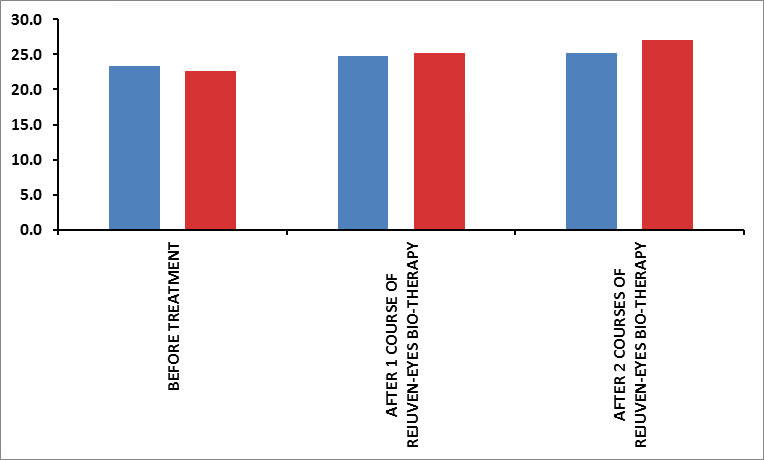
GRAPH 1: RESULTS OF TREATMENT WITH 2 COURSES OF REJUVEN-EYES BIO-THERAPY ON MEAN SENSITIVITY OF LEFT AND RIGHT EYES.
[Mean Sensitivity is the overall average (in decibels) of all responses in all test locations from the visual field test.]
Results
Mean sensitivity improved in both the left eye (blue columns) and right eye (brown columns) after 2 courses of treatment with Rejuven-Eyes Bio-Therapy.
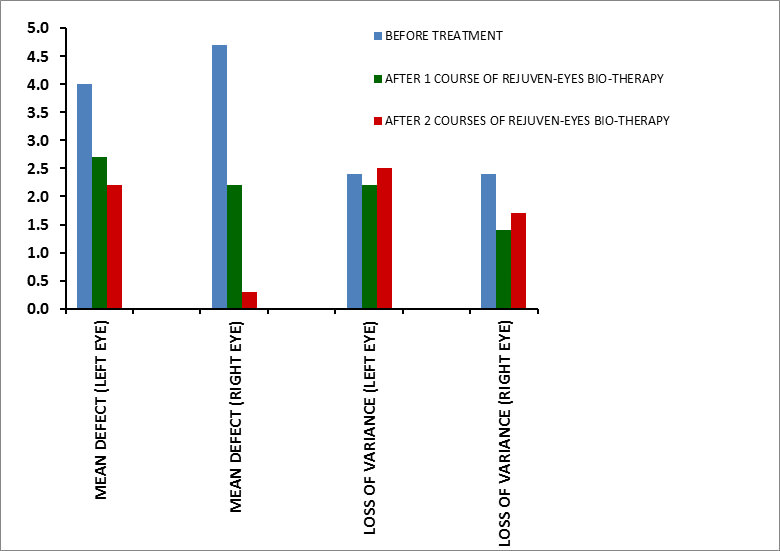
GRAPH 2: RESULTS OF TREATMENT WITH 2 COURSES OF REJUVEN-EYES BIO-THERAPY ON MEAN DEFECT AND LOSS OF VARIANCE IN LEFT AND RIGHT EYES.
[“Mean Defect” is the average deviation of sensitivity at each test location from age-adjusted normal population values. It is an indication of the degree of generalized or widespread loss in the visual field and also signifies the overall severity of visual field loss.
“Loss of Variance” indicates the amount of localized visual field loss. It is small in generalized damage and increases with the number and depth of localized scotomas.]
Results
Mean defect improved in both the left and right eyes after 2 courses of treatment with Rejuven-Eyes Bio-Therapy.
Loss of variance remained unchanged in the left eye, but improved slightly in the right eye after 2 courses of treatment with Rejuven-Eyes Bio-Therapy.
The sad fact is that if you have been diagnosed with Dry Macular Degeneration, no drug or treatment available today can save your vision.
However, there’s no need to lose hope.
Rejuven-Eyes Bio-Therapy has been shown to –
- Quickly and painlessly stop progression of vision loss in patients with dry macular degeneration after just one course of treatment lasting 20 days!
- Restore lost vision in a significant proportion of patients,
- Without causing any side effects or adverse reactions in a single patient.
If you are suffering from Dry Macular Degeneration, or know someone who does –
We strongly recommend that you get in touch with us right away to learn how you can prevent further damage to your precious vision – and perhaps even recover some of your lost vision!